
Durham City Directory Collections
Durham County Library’s North Carolina Collection is the practical starting point for local printed directories. It reports annual city and county issues from the late nineteenth century to the present, with annual print volumes back to 1903 and examples from 1892. The collection preserves more than a name list: alphabetical listings, address or street sections where the edition has them, telephone books, and later cross-reference volumes. For a year not online, the library is the custodian to contact before assuming the volume is missing.
| Collection | Years | Where Held | Access |
|---|---|---|---|
| Durham city and county directory print run | Late 1800s to present; annual print from 1903, with 1892 examples | Durham County Library North Carolina Collection | Print and local collection access; request help for non-digitized volumes |
| DigitalNC Durham directory collection | Durham items within 1875-1963 | DigitalNC | Search online by place and year, then inspect page images |
| Telephone directories | 1927; 1950-2016 | North Carolina Collection | Library use for number and address clues |
| Greater Durham Area Cross Reference | 1962 to present | North Carolina Collection | Telephone and street-address cross-reference |
Start with the format that matches the question. An alphabetical volume is better for a known name. A street or cross-reference volume is better when the address comes first. The printed record is historical context, not a current-person locator. The library’s directory inventory explains the local runs and points to the digitized route.
The Durham County Library directories page is the source for this view of the collection.
Use the collection description to choose a date and section before asking staff for a volume or a research copy.
Durham City Directory Access at the Library
The North Carolina Collection is on the third floor of the Main Library at 300 N Roxboro Street. Its contact route is ncc@dconc.gov or 919-560-0171. Nonresidents may submit materials requests. Microfilm and other non-digitized items still require an in-person visit or a research request, which matters when a directory year is absent from a web collection. The same collection gathers biography files, newspapers, maps, yearbooks, cemetery sources, and local indexes that can test a directory finding.
Ask for the edition, year, and section rather than a broad name search. That gives staff a usable request and keeps the citation trail clear. An address from a directory can also be checked against maps, aerials, planning files, or a recorded deed, but none of those sources proves the same thing.
The library’s genealogy and indexes collection documents the companion sources available with the directories.
Those indexes can corroborate a date or a name spelling without turning a directory entry into a complete life record.
Note: A no-match may reflect an omitted edition, a spelling variant, a move, or a person who was not listed.
Digital Durham City Directories After Migration
DigitalNC’s Durham search supplies scanned local items in its North Carolina City Directories collection. A representative record is the 1919-1920 Durham directory. Search by year and location, then save the record URL, image or PDF page, publisher, and section. Page images are especially important where initials, abbreviations, and street directions can change the meaning of an entry.
Digital Durham is a different Duke collection with letters, ledgers, maps, photographs, and printed works. It migrated platforms on July 9, 2025. The updated platform adds indexed and transcribed letters and ledger material, but the old interactive 1880 census database is no longer archived there. A search that once relied on the former interface needs to begin again with the current metadata and collection paths.
Digital Durham’s 2025 update notice records the migration and the status of the former census feature.
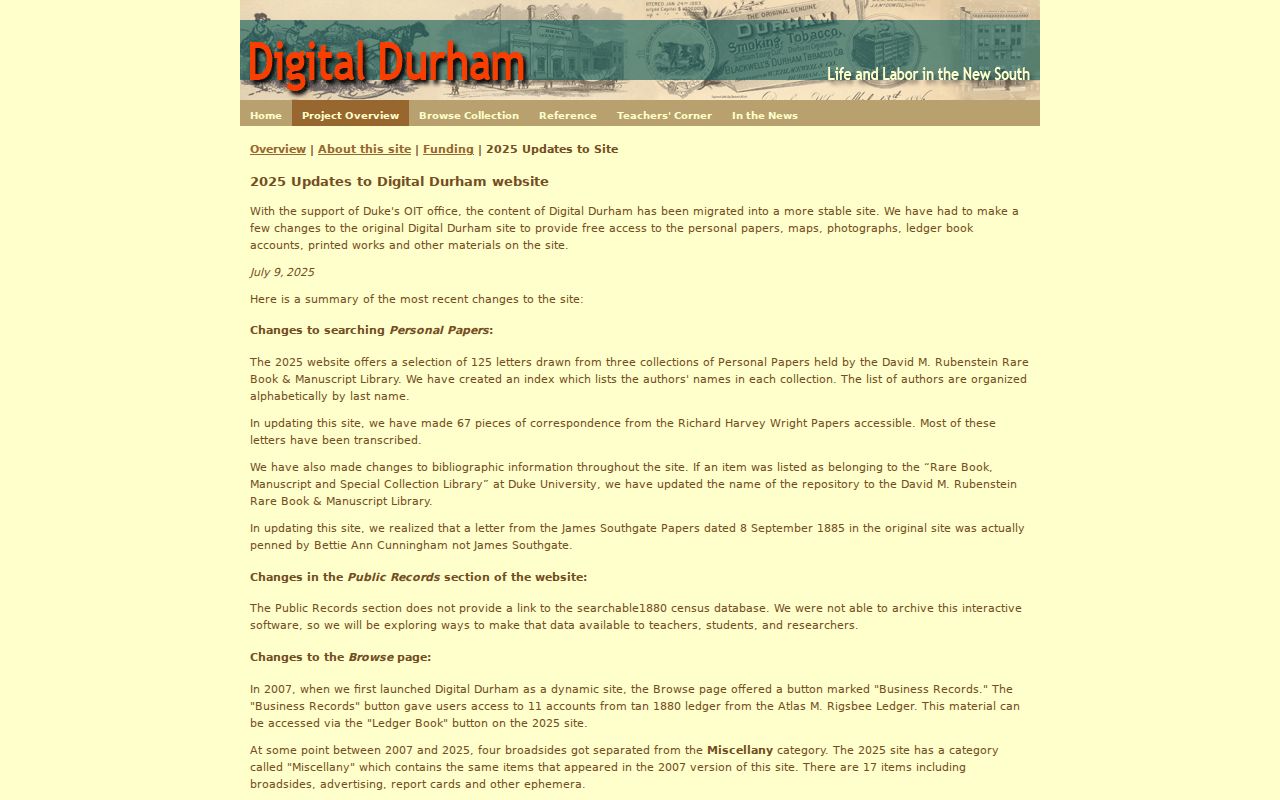
The platform change is a search-method caveat, not evidence that a person or a household has disappeared from the historical record.
Reading a Durham City Directory Entry
A directory entry should be transcribed as several small facts, not summarized as a biography. The edition may print a surname and initials, a household notation, an occupation or business role, an address, a telephone number, or a tenure mark. Copy each item as printed. The publisher’s abbreviation key is evidence too. Do not expand an abbreviation from memory when the edition provides its own key.
| Edition and publisher | Record the exact year, volume, publisher, page or image, and section. |
|---|---|
| Printed name | Keep spelling, initials, suffixes, widow or married forms, and cross-reference marks. |
| Household notation | Copy a spouse or relative notation only when the entry actually prints it. |
| Occupation or business | Transcribe the descriptor and any printed employer or business line as historical context. |
| Address and telephone mark | Preserve the street number, direction, unit, old spelling, and telephone indication where supplied. |
- Criss-cross directory
- A reverse or cross-reference volume arranged to connect an address or telephone clue back to a printed name.
- Householder index
- An index that directs the reader to the listed household or address entry. It does not establish every person who lived there.
- Abbreviation key
- The edition’s explanation of its marks and shortened terms. Read it before interpreting an occupation, relationship, or address notation.
Comparing the alphabetical listing with the street section preserves both sides of the evidence. Keep the page and section for each, especially when a cross-reference points elsewhere in the book.
Durham City Directory Street Sections
Durham directory street sections generally begin around the 1919-1920 volumes. Those editions organize listings with north and east designations and rising house numbers. Before that point, use the alphabetical listing first, then compare deeds, tax records, newspapers, Sanborn maps, or city maps. An address search before 1919 should not assume that a modern-style street index exists.
The 1956 introductory matter identifies the Hill Directory Company as a Durham publisher since 1903 and names Bragtown, Hope Valley, Joyland, Rockwood, Rollingwood, Sherron Acres, and Tuscaloosa Forest among the areas included in that historical scope. Those names help interpret the volume’s reach. They are not a statement about a present boundary.
The library’s maps and large-materials collection is a useful place to compare an old street alignment, plat, aerial, or planning record with the printed address.
A map can provide street and building context, while the directory supplies a dated printed listing. Neither source should be stretched into proof of current residency.
Durham Directory Years in Context
The chronology explains why two records that look similar can answer different questions. Durham existed as a place before Durham County was created, so an early place name can predate county record books. Directory publishing, street indexing, telephone service, and electronic discovery developed on separate tracks.
- 1892: The North Carolina Collection holds examples from the late nineteenth century.
- 1903: Annual print directories begin in the library’s documented run, and the 1956 material identifies Hill Directory Company publishing in Durham from that year.
- 1919-1920: Street sections generally begin, making address-oriented reading more practical for later volumes.
- 1927 and 1950-2016: Telephone-directory runs add number and address clues.
- 1962 to present: Greater Durham Area Cross Reference volumes combine telephone and street-address information.
The count of formats matters. One person may appear in an alphabetical entry, a street section, and a telephone or cross-reference volume, each with a different printed purpose. Record the edition date before connecting those entries to a census, deed, or newspaper.
Tracing Families With Durham City Directories
Begin with a known year and work forward or backward in manageable steps. Read the alphabetical entry, then use the street section or a cross-reference volume where available. Pair a directory year with the appropriate released federal census schedule. Federal census microdata follows a 72-year public-access rule, so it is a dated household source, not a current lookup. A disappearance can reflect a move, an omitted issue, a missed enumeration, or an exclusion. It does not confirm a death or departure by itself.
- Save the first confirmed listing with its year, page, section, publisher, and exact spelling.
- Check nearby annual, five-year, or ten-year editions and note every address, spouse form, and occupation change.
- Compare the address with the street section or Greater Durham cross-reference when its date range applies.
- Pair the directory date with an available census release, keeping the directory’s publication year separate from the census year.
- Test a possible end point against an announcement, obituary index, deed, cemetery source, or original newspaper item.
For a modern verification question, a dated directory finding needs a different record type. The Durham resident lookup route is better suited to checking an official current index while preserving that date distinction.
Note: Cite the volume and page alongside a directory finding so another researcher can check the original printed context.
Durham Directory Clues and Announcements
The library’s obituary index covers 1848-1927, while its birth, marriage, and divorce announcement index reaches from the 1800s through 1911. Both are indexes, not certificates. The original item is on Main Library microfilm, and the library supplies newspaper-title abbreviations. Titles include the Durham Daily Globe, Durham Tobacco Plant, Durham Herald, Durham Recorder, and Durham Sun among related local papers.
Use an announcement index to locate a page or title, then verify the underlying newspaper item. For events from 1913 forward, the research route shifts to the Register of Deeds or North Carolina Vital Records as the appropriate custodian, and divorce verification belongs with the Clerk. A newspaper notice can add family context, but it does not replace the official record.
Durham’s archival context is wider than print volumes. Duke Rubenstein collections include North Carolina Mutual Life Insurance Company Archives, Lincoln Hospital Records, C.C. Spaulding papers, and the Rencher Nicholas Harris Papers. Those collections can help explain an institution or community named in a listing, provided the collection item itself is cited.